LL-HLS or WebRTC: which live-streaming architecture?
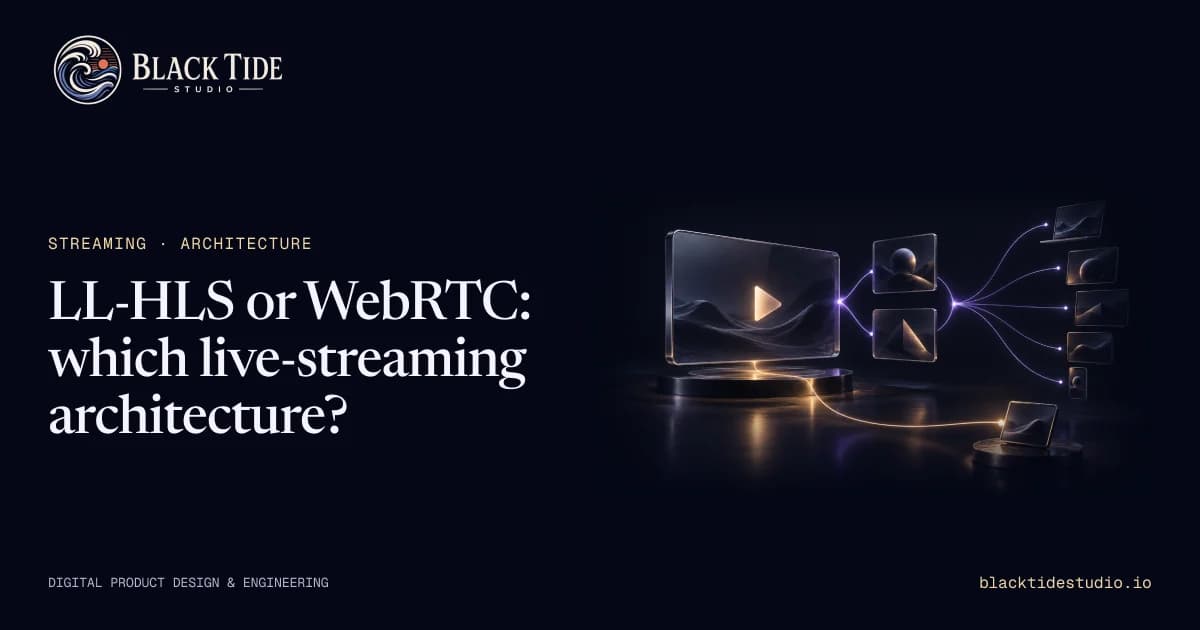
LL-HLS scales distribution; WebRTC prioritises interaction. Compare the trade-offs and design an observable, resilient live architecture.
Choosing between LL-HLS and WebRTC is not a matter of pitting a slow protocol against a fast one. They solve different problems. LL-HLS distributes a stream to an audience. WebRTC creates interactive media connections between participants. The right decision depends less on an abstract latency target than on the roles in the live experience: who publishes, who watches, who speaks and which actions must stay in sync.
This distinction prevents an expensive mistake: forcing the presenter, guests and every viewer through the same architecture. When a product combines a stage, an audience and business events, the answer is often a set of specialised paths working together.
LL-HLS and WebRTC serve different exchanges
LL-HLS: distributing a programme to an audience
LL-HLS remains HTTP-based. The encoder creates multiple qualities, the packager divides them into short fragments, then an origin and a CDN deliver them to players. Low-latency extensions let a player start receiving a fragment before the complete segment is finished.
This pipeline retains useful HLS properties: caching, adaptive quality, recovery after an interruption and integration with widely understood web infrastructure. It fits products where many people primarily consume a downstream feed across varied devices and network conditions.
The trade-off is a delay introduced by fragment creation, transport and player buffering. LL-HLS also provides no return channel on its own for a bid, chat message or reaction.
WebRTC: taking part in real time
WebRTC prioritises a continuous, bidirectional media session. In a server-based architecture, an SFU receives participants' tracks and forwards them to others. Signalling, codec negotiation, congestion control and network traversal through STUN or TURN are all part of the system that must be designed and operated.
This model suits conversations, co-hosts and interactions where seeing or hearing a response almost immediately is part of the experience. In return, every participant keeps an active connection. Fan-out, TURN relays and session state make capacity planning and diagnosis more demanding as the audience grows.
Start with roles, not protocols
Before selecting technology, map the product's exchanges. A presenter publishing video, a guest joining the stage and a viewer sending a reaction have neither the same media needs nor the same tolerance for delay.
- Prefer LL-HLS when the audience mainly consumes a programme, distribution must absorb traffic changes and playback quality matters more than a video conversation.
- Prefer WebRTC when every participant may publish, speakers take turns or immediate audiovisual feedback is essential to the use case.
- Combine them when a small group produces the live show while a wider audience watches and acts through an application interface.
The latency budget should also be defined per action. A guest's audio return, a confirmed bid appearing in the interface and the video received by a viewer can follow different paths without compromising product consistency.
A hybrid architecture separates three planes
The contribution plane
Hosts and co-hosts publish over WebRTC to the media layer. It manages tracks, permissions and, when needed, composition. This path remains reserved for people who need to interact on stage.
The distribution plane
The resulting programme is encoded at multiple qualities, packaged as LL-HLS and served from an origin behind a CDN. Viewers therefore use a playback path built for distribution without opening a WebRTC session for every member of the audience.
The business plane
Bids, reactions, messages and state changes travel through a dedicated API and real-time channel. The business server remains authoritative: it orders events, checks permissions and returns recoverable state after a reconnect. Video illustrates the action; it never decides the outcome.
This is the principle used for the Blisterr live-auction marketplace: WebRTC for people on stage, LL-HLS for distribution and a separate backend for product interactions. That separation lets each path evolve according to its own constraints.
Balancing latency, cost and interaction
Latency is a chain
Measuring only the protocol often hides the actual bottleneck. Capture, encoding, transport, packaging, cache, player buffer and rendering all contribute to perceived delay. Business events also include server-side validation and interface updates. Each critical journey therefore needs an end-to-end budget.
Cost follows topology
For LL-HLS, the structural cost centres are encoding, optional storage, origin requests and CDN distribution. For WebRTC, they are concurrent sessions, track fan-out, TURN-relayed traffic and media-layer capacity. A useful estimate begins with a live profile—publishers, viewers, qualities and duration—and makes every assumption explicit.
Interaction must survive the media path
A quality change, reconnect or playback delay must not duplicate an action or move the interface back to stale state. Idempotent identifiers, server timestamps and recovery from an event cursor keep the business plane independent from player conditions.
Operating live video: observe every boundary
A black screen can originate in capture, authentication, the encoder, the packager, the CDN or the player. An operable platform connects those signals through a shared session identifier.
- Contribution: publishing state, network loss, quality changes, reconnects and relay usage.
- Processing: encoder health, rendition availability, manifest progress and packaging errors.
- Distribution: origin and CDN errors, cache behaviour, outbound throughput and fragment availability.
- Playback: start time, buffering, quality changes, fatal errors and abandonment.
- Business: real-time channel connections, processing delays, rejected events, recovery and desynchronisation.
Synthetic tests complement production metrics: publish a feed, open a player through different networks, trigger an interaction and verify that the system recovers after an interruption. Alerts should cover the whole experience, not merely servers that are still running.
Common architecture mistakes
- Putting the whole audience on WebRTC only because its advertised latency is lower, without modelling connections and relayed traffic.
- Making business state depend on the player, then discovering that buffering alone can desynchronise the interface.
- Choosing one latency for the entire product instead of defining the needs of presenters, guests and viewers.
- Forgetting degraded modes: publisher recovery, a safe quality fallback, delayed playback or restored business state.
- Testing only on a development machine without covering the devices, browsers and network conditions the product targets.
- Leaving resources alive after the event with no explicit shutdown, archival and deletion policy.
Checklist before committing to the architecture
- Map roles and their upstream or downstream media flows.
- Define acceptable latency for each critical interaction.
- Describe audience shape and expected traffic changes.
- List target devices, browsers and network conditions.
- Choose the source of truth and reconnection strategy.
- Plan permissions, access tokens, moderation and revocation.
- Decide whether the live event is recorded, replayed or clipped.
- Model component costs from explicit product assumptions.
- Define metrics, traces, alerts and synthetic tests.
- Test load and failure modes before the first public event.
The best architecture is one the product can operate
LL-HLS and WebRTC are building blocks, not a complete strategy. A sound system reserves interactive connections for the roles that need them, distributes the programme efficiently to viewers and keeps business rules in an independent, observable plane.
The media protocol does not decide the client architecture either: our Flutter or native iOS/Android guide treats that decision separately.
Black Tide designs these systems through its cloud and product architecture services. If you need to select a stack, take over an existing live platform or prepare it for higher demand, let's discuss your architecture.
Let's discuss your project.
A 30-minute conversation to understand the context, constraints and next step. Technical scoping follows if it is relevant.